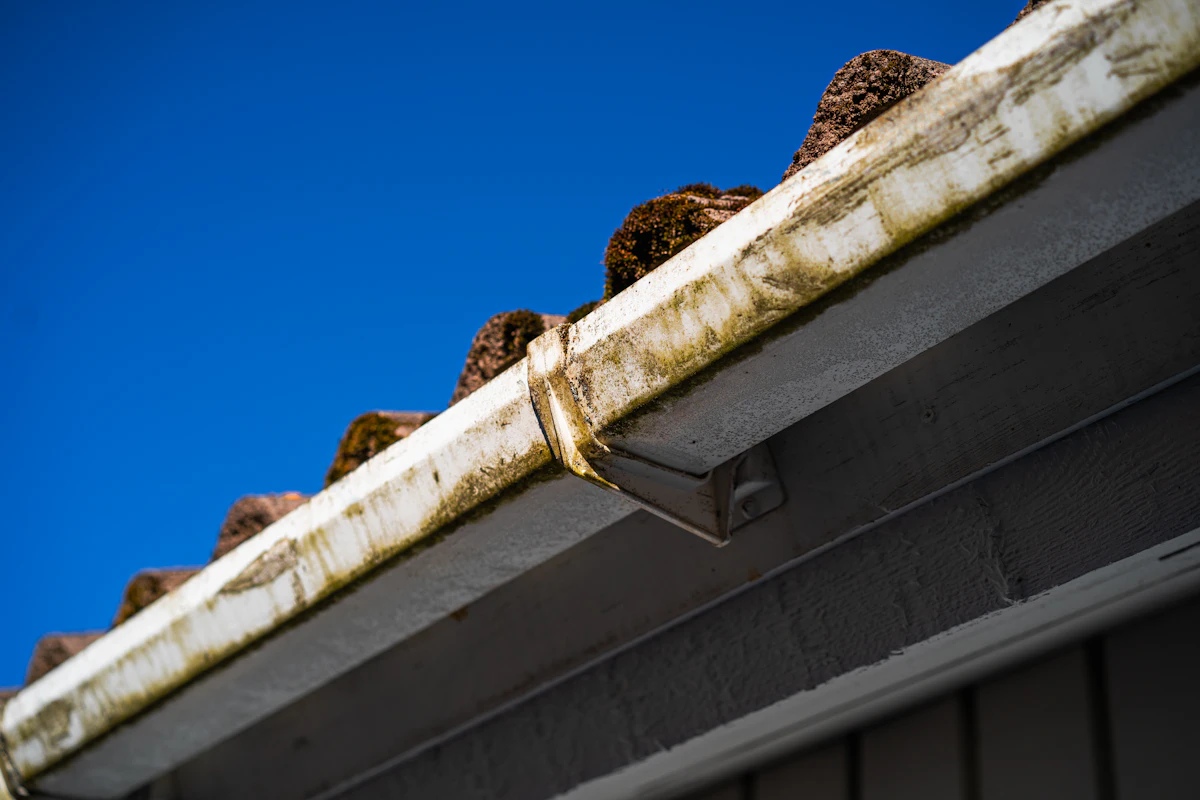
Seamless Gutters in Matthews, NC
Aluminum rolled on site to the exact length of your roofline, hung on sound fascia, and pitched to actually move water. Sardis Plantation to Crestdale, across Mecklenburg County.
Seamless Gutter Installation for Matthews NC Homes
Seamless gutters in Matthews, NC cost $5.60 to $9.80 per linear foot installed in aluminum, which puts a typical 145 linear foot home at roughly $812 to $1,421, and a full replacement including tear off and disposal at $1,300 to $2,200. The reason Matthews homeowners end up on a page like this one is rarely price, though. It is that the gutters they have keep overflowing, and nobody has told them whether that is a cleaning problem, a pitch problem, or a sizing problem. Those three have completely different fixes and wildly different costs.
Matthews sits on the southeast edge of Mecklenburg County with a housing stock that is unusually easy to read. The bulk of it went up between 1985 and 2005, in identifiable waves, with identifiable builders. Sardis Plantation came out of the ground between 1987 and 1997 under the William Trotter Company. Brightmoor, Callonwood, Matthews Plantation, and Brookhaven followed the same production pattern that ran across the whole southeast Charlotte crescent. That matters because production builders specify the minimum gutter system that satisfies the plan, and the plan does not know what your specific lot looks like after thirty years of oak growth.
Charlotte area rainfall is 43.60 inches a year under the NOAA 1991 to 2020 normals, against a national average near 38 inches. More useful than the annual figure is the shape of it: August averages 4.35 inches, June 3.99 inches, July 3.74 inches, and most of that arrives as short, violent summer convection rather than steady drizzle. A gutter system in Matthews is not being asked to handle a gentle flow for long periods. It is being asked to absorb a large volume in a short window, repeatedly, for decades. Systems that were marginal on the day they were hung show it here inside ten years.
Not sure whether you need new gutters or a repair? If the trough is sound and the problem is one sagging run or a leaking corner, start with gutter repair. If failures show up on three or more elevations, see gutter replacement.
What Gutters Cost in Matthews, and What Moves the Number
A new seamless aluminum system on an average Matthews home lands between $812 and $1,421, and a replacement that includes stripping the old system lands between $1,300 and $2,200. Where a specific house falls inside those ranges comes down to five things, and every one of them is worth understanding before you compare two quotes that look different for no obvious reason.
Trough size
Moving from 5 inch to 6 inch K style adds roughly 10 to 20 percent to the material line, and on the larger two story plans across Matthews it is usually money well spent. Six inch trough with 3 by 4 inch downspouts moves substantially more water than 5 inch with 2 by 3 inch. If your current gutters overflow when they are clean, you are paying for that difference one way or another, either in gutter or in foundation work later.
Corner count
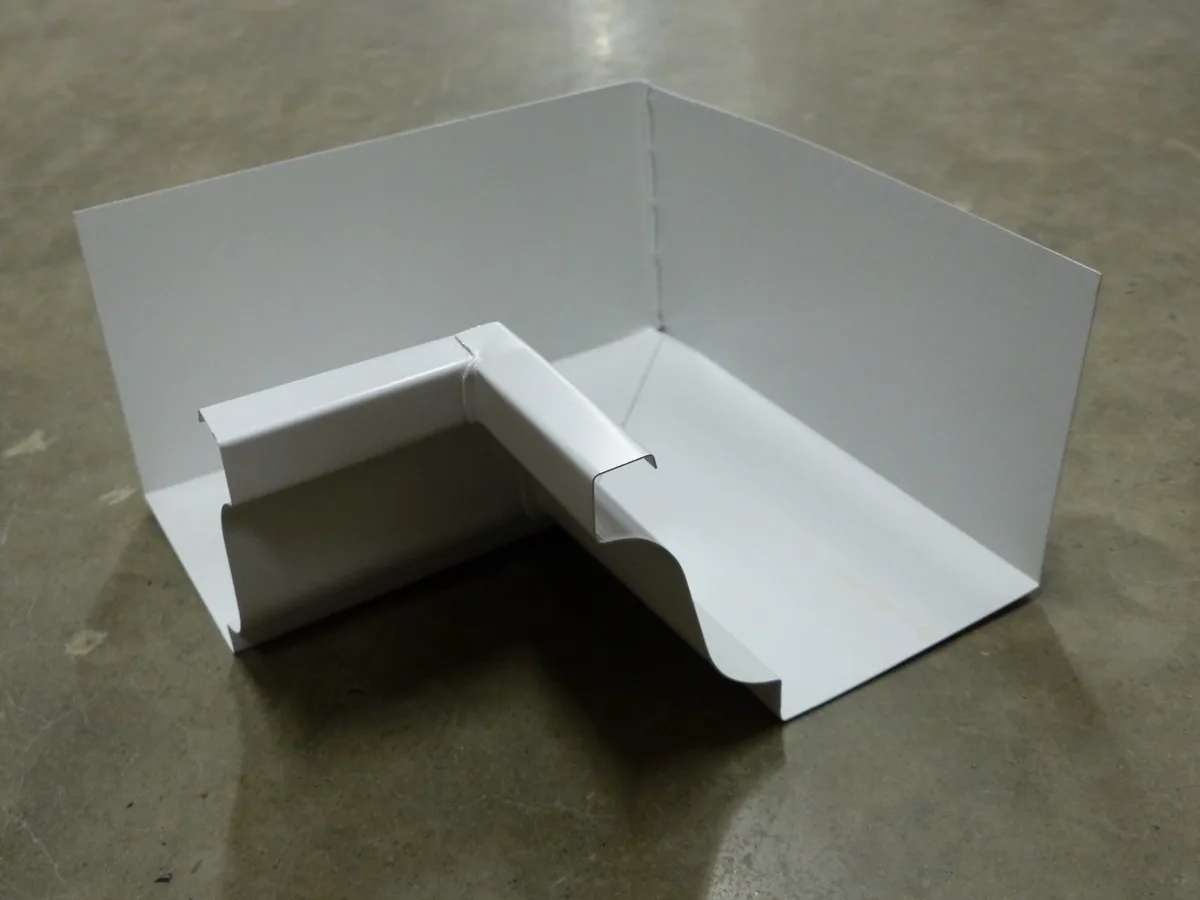
Every inside and outside miter is a hand formed, hand sealed joint, and it is one of the very few joints a seamless system still has. A simple ranch with four long straight runs is cheaper per linear foot than a house of identical total footage broken into a dozen short runs with gables, dormers, and bump outs. When two quotes on the same Matthews house differ by several hundred dollars, corner count is usually the reason.
Fascia condition
Fascia is the wildcard on every replacement and it cannot be priced honestly until the old gutter is off. Rotted sections are cut out and replaced at roughly $8 to $20 per linear foot depending on length and access. On a house where the gutters have been overflowing for several seasons, expect some. On a house where the old system simply aged out while still draining properly, often none.
Height and access
Two story work adds 15 to 25 percent, which is not a surcharge for its own sake but ladder staging, slower material handling, and a second person spotting for most of the day. Steep pitches, walkout basements that turn one elevation into effectively three storeys, and tight side yards all push toward the upper end of that band.
Material
Aluminum is the default and the right default for the overwhelming majority of Matthews homes. Standard residential coil is .027 gauge; heavier .032 gauge costs a little more and resists denting from ladders and falling limbs noticeably better, which is worth considering on the wooded lots off Sardis Road North. Copper at $25 to $50 per linear foot belongs on the older architecture around Downtown Matthews rather than on a 1998 production two story. Full rates are in our Charlotte gutter cost guide.
Matthews Neighborhoods and What Each One Actually Needs
Matthews is not one gutter market, it is several, and the right specification changes by street. The oldest stock in and around Downtown Matthews needs different work from a 2003 two story in Callonwood, and both need different work from a Sardis Plantation home that has just crossed the thirty year line. Here is how the town breaks down from a roofline point of view.
Built between 1987 and 1997 by the William Trotter Company off Sardis Road North. These homes are now approaching or past the 30 year mark, which is exactly the end of the service window for the original aluminum. Nearly everything we quote here is a full replacement rather than a repair, and the hardwood canopy that has matured over three decades means fascia inspection is never a formality.
A planned community with two pools, tennis courts, and walking trails. Amenity heavy neighborhoods like this tend to have covenants that specify approved exterior colors, so confirm the palette before coil is ordered. Typical homes here carry 140 to 180 linear feet of gutter with a moderate corner count.
Newer stock than the Sardis Road corridor, with larger roof planes and steeper pitches on the two story plans. The gutters here are rarely worn out; they are undersized. Chronic overflow on a clean 5 inch trough is the signature complaint, and the fix is 6 inch with 3 by 4 inch downspouts.
Established streets with substantial tree cover and a mix of one and two story homes. Downspout placement is the recurring issue: original layouts often put too much roof area on a single outlet, so the trough backs up at the corner nearest the downspout long before it overtops anywhere else.
Mid size lots with mature plantings tight to the foundation, which makes downspout discharge the thing to get right. Splash blocks that dump against a bed and a slow draining clay subsoil is how you end up with a wet crawlspace on an otherwise sound house.
Larger homes on the Charlotte side of the Matthews line, generally two story with complex rooflines, multiple gables, and higher corner counts. Access staging is a real cost driver here, and 6 inch trough is close to standard on the bigger plans.
The oldest building stock in town, and the only part of Matthews where half round profile and copper regularly make sense on the architecture. These are also the homes most likely to still have galvanized steel gutter, which rusts from the inside of the trough where nobody sees it until it perforates.
One of the oldest African American communities in North Carolina, and a designated stop on the Matthews Heritage Trail, which runs from behind Town Hall and the library through Crestdale to the Four Mile Creek Greenway at John Street. Housing here is older and varied, so every quote is measured rather than estimated from a plan type.
Five Inch or Six Inch on a Matthews Roof
Six inch K style is the right choice on most two story Matthews homes, and 5 inch is adequate on smaller single storey roofs with short runs and generous downspout placement. Four inch does not belong on a residential roof plane at all here; it is a porch, garage, and shed profile. The decision is made from three inputs, and none of them is what size is currently on the house.
The first input is drainage area, meaning the horizontal footprint of the roof plane feeding that particular run. The second is roof pitch, because a steep plane delivers its water to the gutter faster than a shallow one of the same area, effectively increasing the peak flow. The third is rainfall intensity, which is the five minute peak rate the system has to survive rather than the annual total. NOAA publishes that figure by location through its Precipitation Frequency Data Server, and for the Charlotte area it is high enough that plenty of 5 inch installations in Matthews were undersized the day they went up.
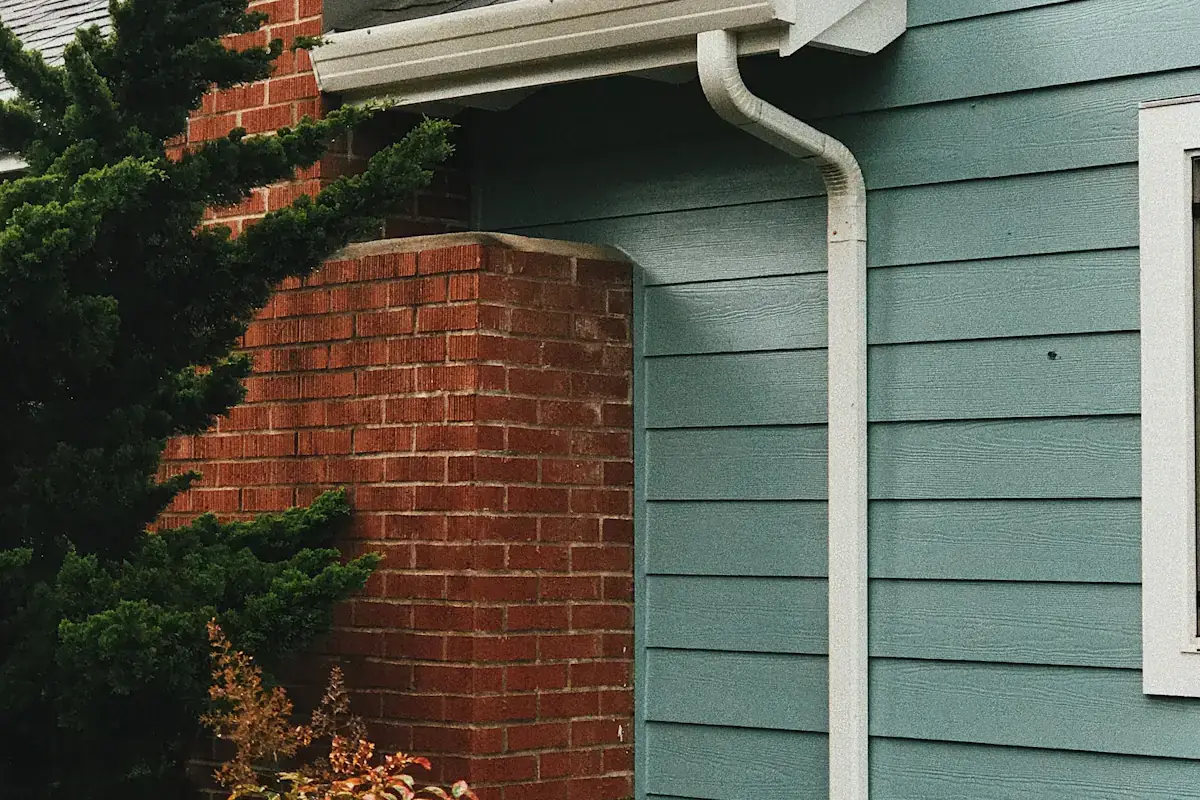
Downspouts are the half of the equation most homeowners never think about. A perfectly sized trough with one outlet on a 40 foot run still floods at the far corner, because the trough is a conveyance, not a reservoir. As a working rule we do not let a single 2 by 3 inch downspout serve more than about 600 square feet of roof, or a 3 by 4 inch serve more than about 1,200. Our Mecklenburg County gutter sizing guide works through the arithmetic with examples.
How We Install Seamless Gutters in Matthews, Step by Step
A standard single family installation in Matthews runs start to finish in one day, typically seven to nine hours. Because the aluminum is formed on a truck mounted machine from coil stock, there is no fabrication lead time to wait on. Here is the sequence so you know what is happening on your roofline and when.
We measure every run elevation by elevation, count inside and outside miters, and record existing downspout positions. Corner count drives both price and future reliability more than total footage does, so it gets written down rather than eyeballed.
Each roof plane is sized against its outlet. This is where we decide whether the existing 5 inch trough is adequate for a Matthews roof or whether the plane calls for 6 inch with 3 by 4 inch downspouts, using roof area, pitch, and local rainfall intensity rather than matching whatever is up there now.
Every foot of fascia behind the old gutter gets probed for soft spots before a price is finalised. On homes where the gutters have been overflowing for several seasons, expect some rot. We quote fascia as a per foot contingency rather than a lump guess so you pay for what is actually cut out.
The old gutters, downspouts, straps, and spikes come off first and leave the property the same day. Aluminum goes to recycling rather than landfill. This step is also the only honest fascia inspection, because nothing can hide behind a system that is no longer there.
A coil of pre finished aluminum runs through the forming machine on the truck and is cut to the exact length of each roofline segment. There is no fabrication lead time and no lap joint anywhere along the length of the run. Miters are cut, fitted, and sealed by hand.
Hidden hangers are screwed through the trough into the rafter tails at 24 inch spacing, tightened to 16 inch on high load elevations. Each run is pitched roughly a quarter inch per 10 feet toward its outlet, and downspouts are placed so no single outlet carries more roof area than it can move.
Every run is flooded with a hose from its high point to confirm pitch, check the outlets, and verify that no miter or end cap weeps. Fasteners and aluminum offcuts are magnet swept from the beds and driveway before the crew leaves the property.
How Gutters Fail on Matthews Homes
Gutters in Matthews almost never fail because the aluminum wore out. They fail because the fascia behind them rotted, because pine needles plugged an outlet, or because the trough was undersized on the day it was installed. Knowing which of those you have is the difference between a $300 repair and a $1,800 replacement, so here is what we look for on an assessment.
The most common failure in Matthews and the most expensive to ignore. Years of overflow soak the fascia board, the board softens, hangers lose their grip, pitch drops, and the trough starts holding water. The gutter still looks fine from the ground the entire time.
Pine needles do not float through a gutter the way leaves do. They weave into a mat, migrate to the downspout outlet, and form a plug that holds water in the trough between rains. Standing water accelerates corrosion from the inside and adds dead load on the hangers.
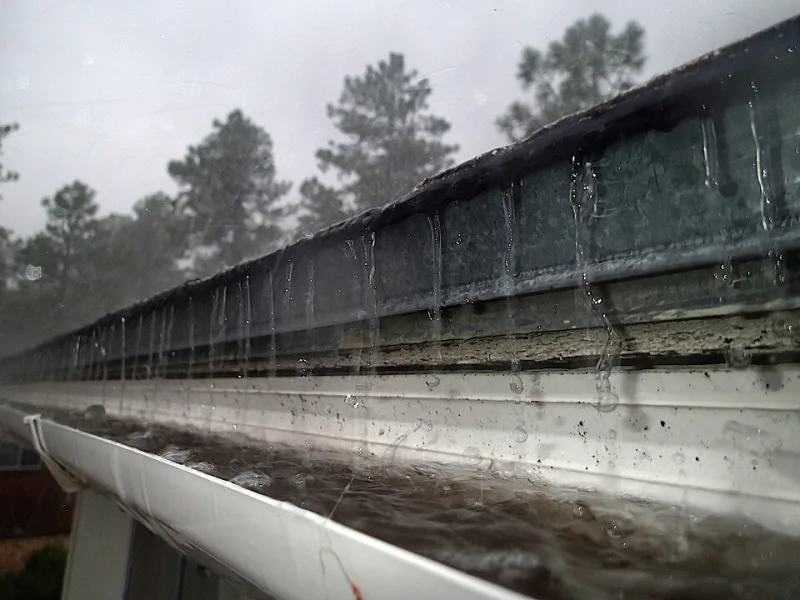
A production builder specification that was marginal on day one. During a 4 inch August rainfall month the water sheets over the front lip even on a spotless gutter. No amount of cleaning fixes it because it is a volume problem, not a debris problem.
Older Matthews homes from the late 1980s often still have spike and ferrule hangers driven into the fascia. Every freeze and thaw cycle works the spike loose a fraction, and Charlotte area winters deliver roughly 40 freezing nights a year. Eventually the run sags between spikes.
A 40 foot run draining to one outlet has to move all its water to one end. The far corner floods first and the overflow lands in exactly the same spot every storm, which is why you often see one eroded trench in an otherwise fine flower bed.
On a seamless system the corners are the only remaining joint, so they are the only place a leak can start along the run. A hand formed miter that was riveted but under sealed will weep quietly for years and stain the siding directly below it.
The Matthews tree canopy problem
Tree cover is the single biggest variable separating one Matthews gutter from another on the same street. On the established blocks, forty years of oak and pine growth have closed over rooflines that were open when the houses were new, and the maintenance interval that worked in 1995 does not work now. Oak tassels drop in late spring and are small enough to pass the trough but large enough to pack an outlet. Pine needles are worse, because they mat rather than float, and a needle mat will hold water in the trough between rains.
This is where guards earn their money in Matthews, and also where most guard purchases go wrong. Screen and foam types underperform badly against pine needles, which thread straight through the openings and then sit in the trough where they are harder to remove than they were before the guard went on. Micro mesh is the only category that reliably keeps needles out, and it costs accordingly. Our gutter guards page covers the categories honestly, including where guards are a waste of money.
Gutter Materials for a Matthews Home
Pre finished aluminum is the correct material for the large majority of Matthews homes, with copper reserved for the older architecture near the town centre and steel and vinyl ruled out by the climate. Here is the whole menu with what each one actually costs and where it belongs.
The default on Matthews homes and the right default for most of them. It does not rust, it is light enough to hang without overloading older fascia, and it comes pre finished in a wide colour range so it never needs painting. Service life 20 to 30 years here.
Same metal, heavier coil. Worth the small premium on wooded lots off Sardis Road North and anywhere ladders get leaned on the gutter regularly, because it resists denting from limbs and rungs noticeably better without changing anything else about the system.
A different tier, and one that belongs on the older architecture around Downtown Matthews rather than on a 1998 production two story. Copper lasts 50 years or more and patinas rather than degrades, but it needs different hangers and more careful joint work, which is reflected in the labour.
Stronger than aluminum against impact, but in a climate with 43.6 inches of annual rain and high summer humidity the galvanizing eventually gives out and the trough rusts from the inside where nobody can see it. A large share of the perforated gutter we tear off around Matthews is steel.
Cheap and widely sold, and we do not put it on Matthews homes. Carolina UV makes it brittle within a handful of years and it sags between hangers under the weight of a hard summer rain, which is exactly the load it needs to survive here.
Two approaches look deliberate: match the fascia and trim so the gutter visually disappears, or match the roof so it reads as part of the roofline. What looks accidental is a white gutter on a house with cream trim, which is usually the result of nobody asking the question.
Permits, Town Rules, and HOAs in Matthews
Standard residential gutter replacement in Matthews needs no building permit, because you are replacing an existing exterior component like for like rather than altering structure. The piece worth understanding is who has jurisdiction if a project does grow past that. Building, electrical, mechanical, and plumbing permits across Matthews are issued by Mecklenburg County LUESA Code Enforcement, not by the Town. Zoning, however, stays local with Matthews Planning and Development, and plan review at the County will not open until the Town's zoning use permit is approved. That is the sequence that catches people out, and it is the same arrangement used in Cornelius, Davidson, Huntersville, Mint Hill, and Pineville.
Where gutters do brush up against review is drainage. Charlotte and Mecklenburg stormwater ordinances prohibit discharging pollutants into the storm system and make obstructing the public stormwater system unlawful. Discharging a downspout to grade, onto a splash block, into buried drain tile on your own property, or into a municipal storm sewer connection are all acceptable approaches. Running a new line into storm drainage that sits on a neighbouring property is different, and requires a good faith effort to obtain permission for the offsite work first. If your project involves trenching a new tie in rather than reconnecting an existing one, ask before you dig. Our Mecklenburg County permit guide goes through the detail.
Separately from permitting, North Carolina contractor licensing under NCGS 87-1 requires a licensed general contractor on any project of $40,000 or more, a threshold raised from $30,000 in 2023. No normal residential gutter job comes close, but it can be reached when gutters are one line item inside a larger exterior scope. HOA covenants are the more likely constraint in Matthews. Most that touch gutters govern colour rather than material and treat like for like replacement as routine maintenance, but amenity communities such as Brightmoor commonly maintain an approved exterior palette. A five minute email to the management company is cheap insurance against taking a full roofline back down.
When to Schedule Gutter Work in Matthews
Spring and early fall are the best windows for gutter work in Matthews. Spring works because the freeze and thaw of December through February has already exposed anything marginal, and because you get the new system in before the May through September storm season rather than during it. Early fall works because you go into leaf drop with a clean, correctly pitched system and sound fascia.
Clear oak tassels and pine pollen once the drop finishes, and check that winter freeze and thaw has not worked any hangers loose. This is the best booking window for replacement work, ahead of the storm season rather than during it.
Peak load. August averages 4.35 inches of rain, June 3.99, July 3.74, and it arrives as short violent bursts. Watch for water sheeting over the front lip on a clean gutter, which is the signature of an undersized trough rather than a dirty one.
The second mandatory cleaning, after the hardwoods are bare. On heavily canopied Matthews streets this is the single most important maintenance date of the year, because a trough full of wet leaves carries real weight into winter.
The Charlotte area sees roughly 40 freezing nights and about 3.5 inches of annual snowfall, almost all of it in January and February. This is not an ice dam climate, but a debris packed trough that freezes solid puts a load on hangers that a clean one never sees.
The window to avoid is immediately after a major storm event, when demand spikes across the entire Charlotte metro at once and every reputable crew books out. Search interest for gutter work in North Carolina peaks in April and again in October, with a second surge through June and July that tracks the storm season. If you already know your gutters are marginal, booking in the shoulder is the difference between choosing a contractor and taking whoever answers.
We work across Mecklenburg and Cabarrus counties. If you are just outside Matthews, these are the neighbouring pages.
Frequently Asked Questions
What are the downsides of using seamless gutters?
Can I buy seamless gutters and install them myself?
Which size gutters are better, 4 inch or 5 inch?
How long will seamless gutters last?
How much do seamless gutters cost in Matthews NC?
Do I need a permit to replace gutters in Matthews NC?
How often should gutters be cleaned in Matthews NC?
What size gutter do most Matthews homes have, and is it enough?
Do seamless gutters go around corners?
Free written estimate on seamless gutter installation in Matthews NC and across Mecklenburg County.